Marsvile Font: A Sci-Fi Tribute to Total Recall and a Call for Martian Workers’ Rights
Imagine scrolling through a futuristic interface—neon-lit, gritty, pulsing with tension—and seeing text that doesn’t just say something, but feels like it’s been etched onto the rusted hull of a Mars colony shuttle. That’s the power of Marsvile: a bold, graffiti-infused display font inspired by the visual language of Paul Verhoeven’s 1990 sci-fi landmark, Total Recall. But Marsvile is more than a stylistic homage—it’s a cultural artifact with real-world resonance, bridging typography, fandom, and advocacy for the imagined (and increasingly plausible) workers of Mars.
What Is Marsvile—and Why Does It Feel So Familiar?
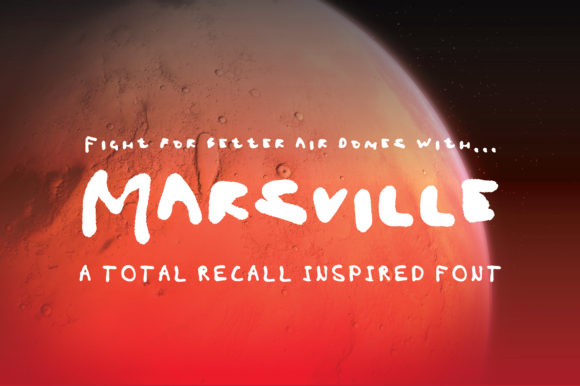
Marsvile is a free, open-source typeface designed to evoke the raw, hand-painted signage seen throughout the Mars Colony scenes in Total Recall. Think flickering holograms, spray-painted warnings on pressurized dome walls, and hastily stenciled manifests on cargo crates bound for the Tharsis mining belt. Its letterforms combine sharp angles, uneven baselines, layered textures, and subtle “grime” effects—mimicking urban graffiti adapted for an off-world context.
Unlike sleek, minimalist sci-fi fonts (like those used in Star Trek or Ex Machina), Marsvile embraces imperfection. Letters tilt, overlap, and appear slightly weathered—suggesting human presence in an otherwise hostile environment. This isn’t sterile futurism; it’s lived-in futurism. And that distinction matters—not just aesthetically, but ethically.
The Real-World Inspiration Behind the Aesthetic
Total Recall didn’t just imagine Mars—it imagined Mars as a workplace. In the film, Martian colonists aren’t explorers or scientists alone; they’re construction crews, maintenance techs, security personnel, and service workers—many of them marginalized, underpaid, and breathing recycled air laced with trace toxins. The graffiti-style signage wasn’t set dressing for cool factor. It reflected resistance, identity, and daily struggle in an authoritarian, corporatized frontier.
Marsvile channels that same spirit. When designers use it for posters, game UIs, or protest art, they’re not just referencing a movie—they’re tapping into a deeper narrative about labor, survival, and dignity beyond Earth.
Why Typography Matters in Sci-Fi—and Why It Should Matter to You
You might wonder: How much can a font really say? More than you’d think. Typography shapes perception faster than dialogue. A clean sans-serif signals efficiency and control; a distressed, hand-drawn type signals rebellion, urgency, or vulnerability. Marsvile sits squarely in the latter camp—and that makes it uniquely valuable today.
In education, it’s used in media literacy units to spark conversations about how design choices reinforce themes (e.g., “Why does the Resistance use rough fonts while the Agency uses polished ones?”). In game development, indie studios adopt Marsvile for diegetic interfaces—screens players see *in-world*, reinforcing immersion without exposition. And in activism, it’s become shorthand for solidarity with speculative labor justice—especially among climate and space ethics communities.
Common Misconceptions About Sci-Fi Fonts
- Myth: “Sci-fi fonts are all about lasers and chrome.”
Truth: The most enduring sci-fi typography—from Blade Runner’s neon-noir signage to Alien’s utilitarian Nostromo labels—is grounded in real-world industrial design, signage systems, and subcultural expression. - Myth: “Fonts like Marsvile are only for fan art or memes.”
Truth: Designers use Marsvile in serious contexts—from university research presentations on extraterrestrial labor policy to NGO campaigns advocating for ethical AI governance in space infrastructure. - Myth: “This is just nostalgia.”
Truth: With NASA’s Artemis program advancing and private missions targeting Mars by the 2030s, Total Recall’s questions about worker safety, atmospheric rights, and corporate accountability are shifting from fiction to policy drafts.
Marsvile as a Catalyst for Real-World Advocacy
Here’s where Marsvile transcends aesthetics: it’s become a quiet rallying point for a growing movement—“Open Your Mind”—a phrase pulled directly from the film’s iconic subway ad, now repurposed as a call to expand empathy beyond planetary borders.
The campaign centers three urgent demands:
- Improve living standards for all Martian workers—including habitat pressure integrity, radiation shielding, mental health support, and fair wages tied to Earth-equivalent purchasing power.
- Recognize and protect “mutants”—not as fictional anomalies, but as individuals with genetic adaptations (natural or therapeutic) to low-gravity, high-radiation, or closed-loop life-support environments. Their rights must be codified—not stigmatized.
- Guarantee breathable air as a fundamental right—not a commodity. Air recycling systems fail. Filters degrade. CO₂ scrubbers overload. When life-support infrastructure is privatized, air becomes negotiable. It shouldn’t be.
This isn’t science fiction hyperbole. Studies from the NASA Human Research Program confirm that prolonged exposure to partial gravity and elevated radiation alters gene expression, immune response, and neurovascular function. Meanwhile, the Outer Space Treaty remains silent on labor rights, environmental standards, or medical autonomy beyond Earth orbit.
How You Can Engage—Beyond the Download
Downloading Marsvile from its official repository is easy—but using it meaningfully requires context. Try these practical steps:
- Educators: Pair Marsvile with lessons on speculative ethics, asking students to redesign colony signage that reflects inclusive safety protocols—not just corporate branding.
- Designers: Use Marsvile in pro-bono projects for space labor coalitions—or embed metadata linking to resources on terrestrial worker protections (e.g., ILO Convention 187).
- Writers & Developers: Integrate Marsvile into worldbuilding docs not just for “cool factor,” but to annotate design decisions: “This warning label uses Marsvile because it mirrors how real maintenance crews tag faulty O₂ regulators—visible, urgent, human.”
- Everyone: Share the “Open Your Mind” message—not as a slogan, but as a question: Whose air are we taking for granted? Whose labor keeps us breathing—on Earth, and beyond?
Looking Ahead: From Font to Framework
Marsvile won’t terraform Mars. But tools rooted in empathy—like thoughtful typography—can reshape how we imagine solutions. As space agencies and startups accelerate plans for permanent settlements, the values embedded in our symbols matter more than ever. A font that celebrates grit over gloss, community over control, and breath over bandwidth reminds us: the future isn’t built by algorithms alone. It’s built by hands—calloused, creative, and demanding dignity.
So yes—download Marsvile. Use it boldly. But also pause before hitting “export.” Ask yourself: Who does this design serve? Who does it center? And what real-world air—literal and metaphorical—am I helping to circulate?
Because in the end, the most revolutionary act isn’t launching to Mars. It’s ensuring everyone who gets there arrives with clean air, fair pay, and the unassailable right to speak up—using whatever font, voice, or medium they choose.