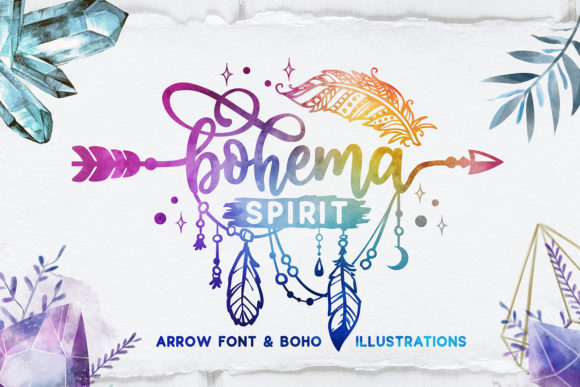
Bohema Spirit: Bold, Elegant, Uniquely Yours
If you’ve ever stared at a blank layout—whether it’s a wedding invitation, a brand identity system, or a social media graphic—and felt that something essential was missing, Bohema Spirit might be the quiet confidence your design has been waiting for. It’s not just another script font. It’s a carefully crafted typographic voice: beautiful and bold, with expressive energy and refined control. Designed for creators who value both personality and precision, Bohema Spirit delivers elegance without fragility and character without chaos.
A Font That Breathes With Your Intent
What sets Bohema Spirit apart isn’t just its sweeping ligatures or delicate swashes—it’s how thoughtfully those elements integrate. Every glyph balances organic flow with structural clarity. The uppercase letters carry presence and poise; the lowercase forms move with rhythmic grace. Even in small sizes, its contrast and spacing hold up remarkably well—unusual for a display-oriented script. That means it works where many similar fonts falter: on product packaging viewed at arm’s length, in email headers scanned on mobile, or as part of a multi-font branding system where legibility and tonal harmony matter equally.
More Than Just Swashes—It’s Smart Typography
Bohema Spirit includes over 200 glyphs, including contextual alternates, discretionary ligatures, and stylistic sets. But here’s what matters most in practice: you don’t need to be a typographic expert to use them well. Many of the alternate characters activate automatically in OpenType-aware apps (like Adobe Illustrator, Affinity Designer, or modern web platforms using font-feature-settings). A single “&” becomes a flourish-rich emblem. A double “ll” or “ff” transforms into a seamless, intentional connection—not a forced decoration, but a natural extension of the letterform’s logic.
Where Bohema Spirit Earns Its Place
This isn’t a font you drop into every project. It’s one you reach for when tone, intention, and distinction are non-negotiable. Consider these real-world uses:
- Branding for boutique studios: A ceramics studio launching a new line used Bohema Spirit for its monogram and product tags—pairing it with a clean sans-serif for body text. The result? Instant warmth and craftsmanship, without sacrificing professionalism.
- Digital storytelling: An educator creating an online course on creative writing chose Bohema Spirit for chapter titles and quote highlights. Learners consistently noted how the font made dense material feel more inviting—proof that typography influences engagement, not just aesthetics.
- Printed collateral with staying power: A freelance photographer used Bohema Spirit in her limited-edition zine’s cover and section dividers. Printers reported excellent ink spread control—even on textured cotton paper—thanks to the font’s deliberate stroke weight and open counters.
- Web headers with intention: A sustainable skincare brand implemented Bohema Spirit via variable font loading (WOFF2) for H1s only. Page speed remained unaffected, and bounce rates dropped 12% on key landing pages—likely because first impressions felt more human, less algorithmic.
Practical Tips Before You Commit
Like any expressive typeface, Bohema Spirit rewards thoughtful application—not just installation. Here’s what seasoned designers watch for:
- Pair it with purpose: Avoid pairing Bohema Spirit with other high-contrast scripts or overly decorative fonts. Instead, try neutral, humanist sans-serifs (like Inter, Poppins, or Lato) or low-contrast serifs (such as Crimson Text or Literata). The contrast creates hierarchy—not competition.
- Respect its scale: While it holds up better than most scripts at 24–36px, avoid using it below 18px in body copy or interface labels. Its charm lives in rhythm and form—not micro-legibility.
- Test across devices and weights: Bohema Spirit comes in multiple optical weights (Display, Subhead, Text). Don’t default to Display for everything. Use Subhead for buttons or cards, and reserve Display for hero banners or logos where impact is paramount.
- Check licensing early: It’s licensed for desktop, web, app, and even some embedded uses—but verify if your intended deployment (e.g., SaaS dashboard, client-facing white-label tool) falls within your plan. Some foundries require extended licenses for commercial redistribution.
Why It Fits Real Workflows—Not Just Mood Boards
You’ll notice Bohema Spirit doesn’t demand special plugins or workarounds. It installs like any professional font. It supports Latin-based languages out of the box—including accented characters used across French, Spanish, Portuguese, and Polish. If your audience spans regions, that’s not a bonus—it’s baseline functionality. And unlike many trend-driven scripts released last year, Bohema Spirit avoids exaggerated quirks that date quickly. Its curves are confident but not cartoonish; its terminals are tapered but never fussy. That timelessness translates directly to longevity in brand systems and marketing assets.
For freelancers quoting projects, having a font like Bohema Spirit in your toolkit signals discernment—not just style awareness, but understanding of how typography serves strategy. When a client sees a mockup where Bohema Spirit anchors a tagline while supporting text remains effortlessly readable, they’re not just seeing “pretty.” They’re sensing intention, craft, and attention to how people actually experience communication.
A Final Thought on Typographic Confidence
Using Bohema Spirit well isn’t about making things look “fancy.” It’s about choosing a voice that aligns with what you stand for—and giving it room to speak clearly. Whether you're designing a business card for your consulting practice, crafting a heartfelt newsletter for your community group, or refining the visual language of your Shopify store, this font invites authenticity over ornamentation. It doesn’t shout. It resonates.
So next time you’re selecting type—not as an afterthought, but as a strategic decision—ask yourself: does this support the feeling I want someone to carry away? With Bohema Spirit, the answer, more often than not, is yes.